Crafting Creativity: The Ideation and Prototyping Expedition

Introduction
The process of ideation stands as a pivotal stage in innovation, offering designers the opportunity to explore new ideas that address user needs and challenges while fostering creativity. Rooted in methodologies such as design thinking and the double diamond process, ideation encourages thinking beyond conventional boundaries, recognizing that even ideas deemed “bad” can lead to breakthroughs through iteration and refinement.
Following ideation, prototyping emerges as a method to manifest these ideas into tangible representations using various tools such as sketches, wireframes, or mock-ups. This approach is invaluable as it provides stakeholders—be it clients, designers, or teams—with a clear understanding of how the proposed idea might function. It also gives a clear understanding of the user flows. Moreover, prototyping serves as a cost-effective means to validate ideas early in the development process, potentially saving significant time and resources that might otherwise be expended on pursuing unsound concepts.
The Process of Ideation
At the core of ideation lies the ability to think creatively and engage in problem-solving. Creativity acts as a catalyst, propelling the process forward towards innovation. Building upon Wallas’s model of the creative process, ideation serves as a pivotal stage where problems are revisited and solutions refined through methods like prototyping, ultimately leading to verification and further development (Sadler-Smith, 2015)
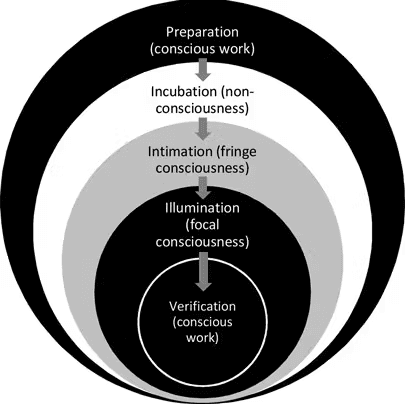
Figure1. Sadler-Smith. 2015. Five stages of the creative process.
Wallas’s framework offers a structured approach to enhancing creativity, guiding individuals through stages of preparation, incubation, ideation, and verification. By understanding and embracing this process, designers can effectively nurture their creativity.
The primary objective of any designer is to simplify users’ lives and ensure that their experiences are both usable and accessible. However, achieving this goal can be challenging, often resulting in what is termed as “Catastrophic UX failure.” Multiple factors contribute to such failures, including inadequate user research and neglecting fundamental UX principles. Among these factors, ideation emerges as a critical juncture in the design process.
How to ideate?
There exists ambiguity amongst designers around “How to Ideate”?
There is significant ambiguity among designers regarding how to ideate a perfect solution. It’s a subjective matter to discuss. In my opinion, it heavily relies on the environment in which a designer operates and the circumstances at play. For instance, if a designer is working on a project with limited bandwidth, resources, and a particular design culture within the organization, the importance attributed to the ideation stage may vary.
In typical industry practices, early ideation consumes a considerable amount of time, especially in startups with tight deadlines. This is where “Rapid Ideation” becomes crucial. Studies have indicated that ideas are generated more swiftly in rapid ideation environments compared to traditional design ideation settings. Additionally, the cost per idea varies inversely (Clark and Reinertsen, 1998). These factors contribute to enhanced productivity, which is indispensable in the early stages of a startup.
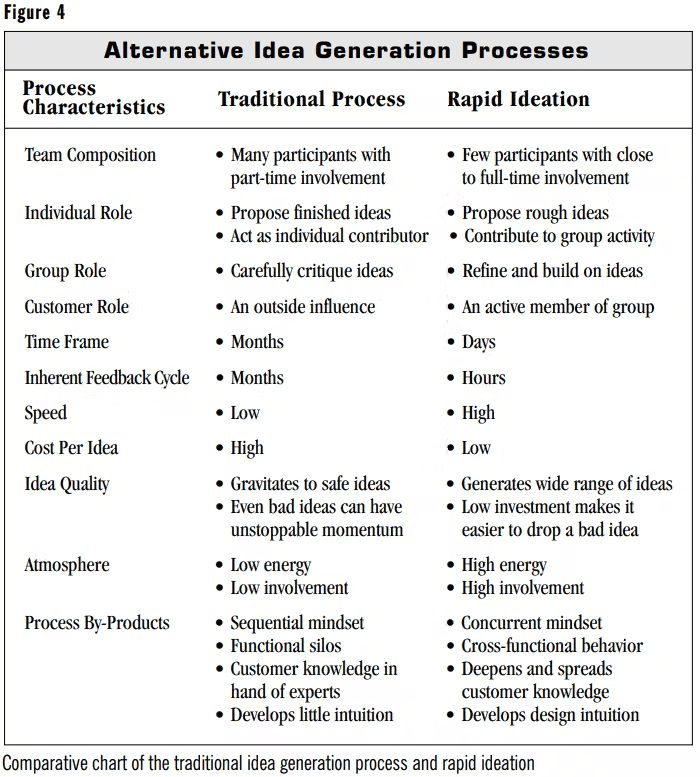
Figure2. CLARK, Brian and Donald G. REINERTSEN. 2010b. Comparative Chart of the Traditional Idea Generation Process and Rapid Ideation
Enhancing Thinking Efficiency
Designers wonder how to come up with better ideas when they can’t always express them out loud. Is there a class or a degree that can teach us to ideate better, or is it just something some people are naturally good at? Designers found this concerning. They were not too worried about whether they could come up with good solutions quickly or slowly.
But Robert Davies did a survey where he interviewed designers from various backgrounds, professions including graphic design, product design, furniture design, textile design, fashion design, engineering design, automotive design, and interior design(Cross, 2011)
Designer 1:
“I believe that this ‘intuitive’ way of thinking may be something that they inherently possess, or it may be something that they developed through their education. Making decisions, or generating proposals, in the design process is something that they feel relaxed about, and for which they feel no need to seek rational explanations or justifications” (Cross 2011:10)
Designer 2:
“He means that, when faced with a blank sheet of paper, he can at least draw something that may at first seem silly or inappropriate, but which provides a starting point to which he can respond; if it doesn’t seem right, why doesn’t it?” (Cross, 2011:12)
Designers’ approaches vary, with some relying on intuition while others prefer using paper and pen to drive ideation, progressing with each iteration. This shows that different designers have different strengths in creating new ideas, which is important. So, designers who don’t naturally have intuition can start practicing it. I think intuition comes from past experiences, and can be developed with practice.
Obstacles
The abundance of content related to ideation and prototyping poses a challenge, as there is a vast amount of material that needed to sift through and understand.
Refining and synthesizing the abundance of content was challenging.
The multitude of methods available for prototyping and ideation adds to the challenge, as designers must navigate through various options to determine the most suitable approach for their specific project or problem.
References
CLARK, Brian and Donald G. REINERTSEN. 2010. ‘Rapid Ideation in Action: Getting Good Ideas Quickly and Cheaply’. Design Management Journal (Former Series) 9(4), 47–52.
CROSS, Nigel. 2018. Design Thinking : Understanding How Designers Think and Work. London: Bloomsbury Visual Arts.
Figure1: SADLER-SMITH. 2015a. Five Stages of the Creative Process. [online]. Available at: https://www.tandfonline.com/doi/full/10.1080/10400419.2015.1087277.
Figure2: CLARK, Brian and Donald G. REINERTSEN. 2010b. Comparative Chart of the Traditional Idea Generation Process and Rapid Ideation [online]. Design Management Journal (Former Series). Available at: https://doi.org/10.1111/j.1948-7169.1998.tb00229.x.
SADLER-SMITH, Eugene. 2015b. ‘Wallas’ Four-Stage Model of the Creative Process: More than Meets the Eye?’ Creativity Research Journal 27(4), [online], 342–52. Available at: https://doi.org/10.1080/10400419.2015.1087277.