Creativity, Technology, and AI: Reflections and Analysis
Introduction
This week’s exploration into creativity and its connection with technology opened up a fascinating journey. We delved into various definitions and methods of approaching creativity, drawing insights from extensive readings of books and academic papers. Additionally, we touched upon the often overlooked but crucial role of imagination in the creative process.
Reflecting on personal experiences where creativity was instinctively applied to redesign or problem-solving in everyday situations brought a new perspective to the forefront.
We also learned about computational creativity and how AI is transforming the way humans can think creatively.
Learnings
Creativity as we discovered, takes different forms – from making something new to seeing things in a fresh light. These were a few definitions and perspectives:
Produce something new, new perspectives, new understanding, transform
elements of newness, innovation, and novelty
and many more…
We also explored practical creative thinking techniques like brainstorming and mind maps, tools that proved valuable in generating innovative solutions.
An interesting takeaway from a challenge was realizing that even seemingly simple things can be improved for better usability through creative thinking.
How AI is being used in creativity?
To address this question, I needed to delve into the workings of AI systems. Drawing on prior knowledge about AI and its intricacies, I found that a quick Google search enhanced my understanding. I discovered that data is fed into the system to train AI (See Fig 1). Consequently, AI proves beneficial in idea generation, serving as a promising starting point for further exploration. While it may not always be perfectly accurate, AI can extend inspiration by suggesting creative concepts.
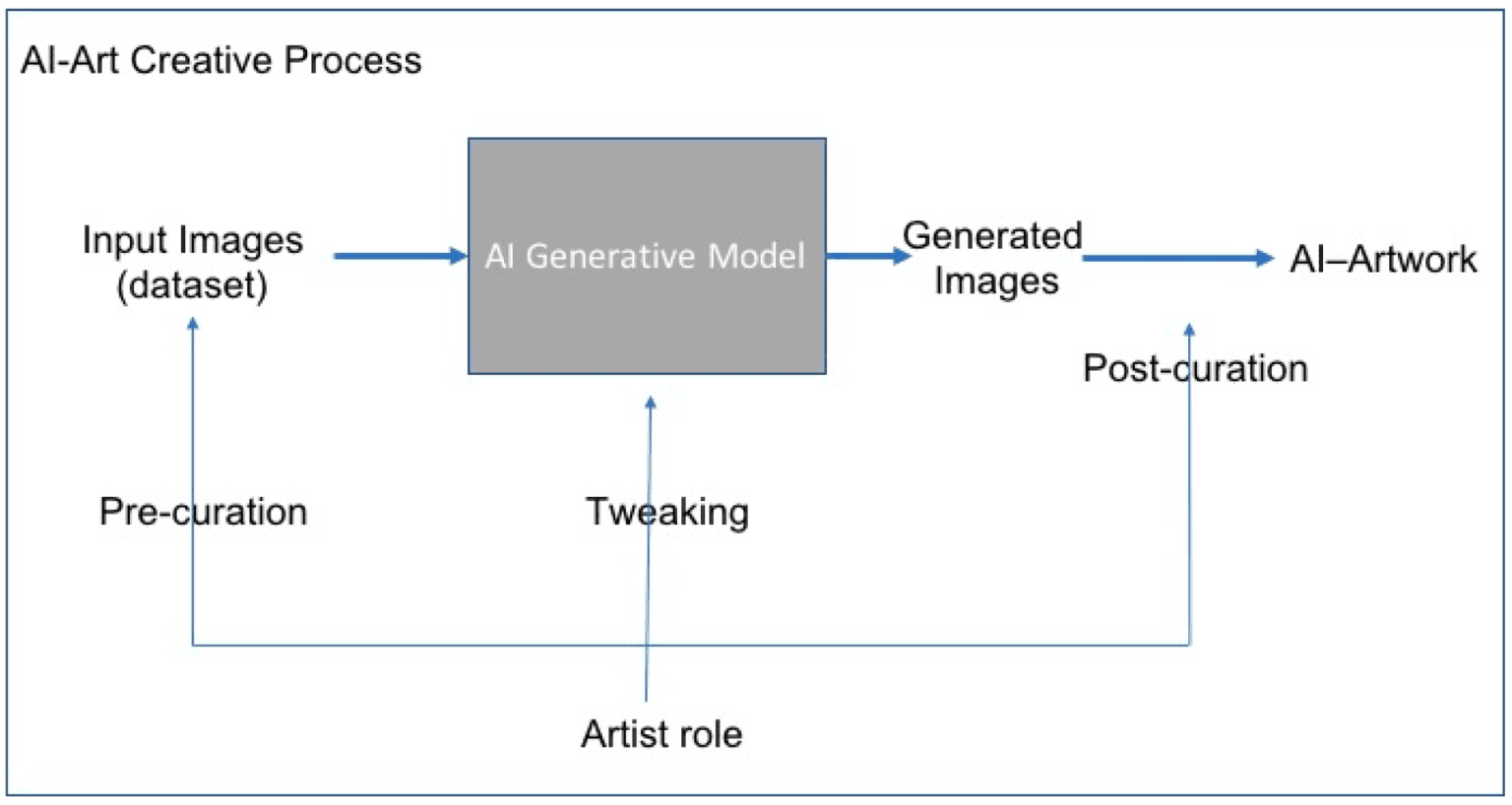
Fig. 1: A block diagram showing the artist’s role using the AI generative model in making art.
Figure 1 explains the process of how an AI-Artwork is created. The artist introduces a collection of images to make the model learn the patterns or characteristics of these images, which is pre-curation. This information is then processed by the AI Generative Model, which generates images that could be relevant or irrelevant but provide us with a direction for thinking out loud.
The artist can now, based on the output, feed the AI Generative Model some new pre-curation data in accordance with the images generated.
Another facet of critical thinking is experimentation, and here, AI tools come into play. They assist individuals in exploring and experimenting with creative concepts by automating specific aspects of the creative process.
Reflections
Creative thinking proved valuable in design work, prompting us to think beyond conventional boundaries. In practical scenarios, where optimizing user experience is key, creative techniques like SCAMPER or MindMaps become useful in navigating challenges.
A dedicated mindset for creative thinking emerged as an essential element, emphasizing the need for an environment conducive to innovative thought processes.
Recognizing the diversity of approaches to thinking about an idea, the challenge lies in finding the one that resonates best with the users’ mindset.
Artificial Intelligence (AI) holds immense importance, and arguably, it can function as a catalyst without overshadowing an individual’s creative thinking process. Essentially, AI doesn’t take complete control or interfere with human thinking abilities; instead, it serves as a guiding force. Picture it as a compass directing humans towards a certain direction, leaving them to explore the path extensively on their own.
Obstacles
The week’s exploration encountered a few obstacles. A minor challenge involved delving deeper into the intricacies of computational creativity, sparking a curiosity to explore this area further for a more profound understanding—a pursuit I eagerly anticipate in the future.
Another challenge was the AI aspect, which has numerous facets related to creativity. With an academic background in technology and some familiarity with AI, I initially found it less demanding. However, as I delved into various articles and journals, I gained a different perspective, making it challenging to assimilate and gather all the learnings at once.
References
Figure 1. Ahmed ELGAMMAL. 2019. A block diagram showing the artist’s role using the AI generative model in making art. From: MAZZONE, Marian and Ahmed ELGAMMAL. 2019. ‘Art, Creativity, and the Potential of Artificial Intelligence’. Arts 8(1), [online], 1–9. Available at: https://www.mdpi.com/2076-0752/8/1/26.