Mobile version under development. Please view on desktop only.

Designing a service booking shop for landscaping business with an 87.9% NPS
Designing a service booking shop for landscaping business with an 87.9% NPS
B2C | Industry project-LIVE (NPS-87.9%)
B2C | Industry project-LIVE (NPS-87.9%)
Residential landscaping require instant measurements to modifies visible land features, comprising garden installation, tree care, lawn maintenance, and other landscape services. Problem users have is the unavailbity of instant measurements and less transparency of the cost they have to bear.
Residential landscaping require instant measurements to modifies visible land features, comprising garden installation, tree care, lawn maintenance, and other landscape services. Problem users have is the unavailbity of instant measurements and less transparency of the cost they have to bear.
Note: Owing to NDA constraints, certain screens and user journey aspects may be absent in this case study. I'd be pleased to discuss it further, separately. 🙂
Participants
Product Manager, Product Designer(me)
Design brief
A homeowner (the user), who lands on a landscaper’s website, should be able to generate an instant quote based on the service he requires, and book the job by making payment to the landscaper then and there. This Homeowner UI is an integral part of the online lawn care shop.
Understand
BUSINESS TYPE
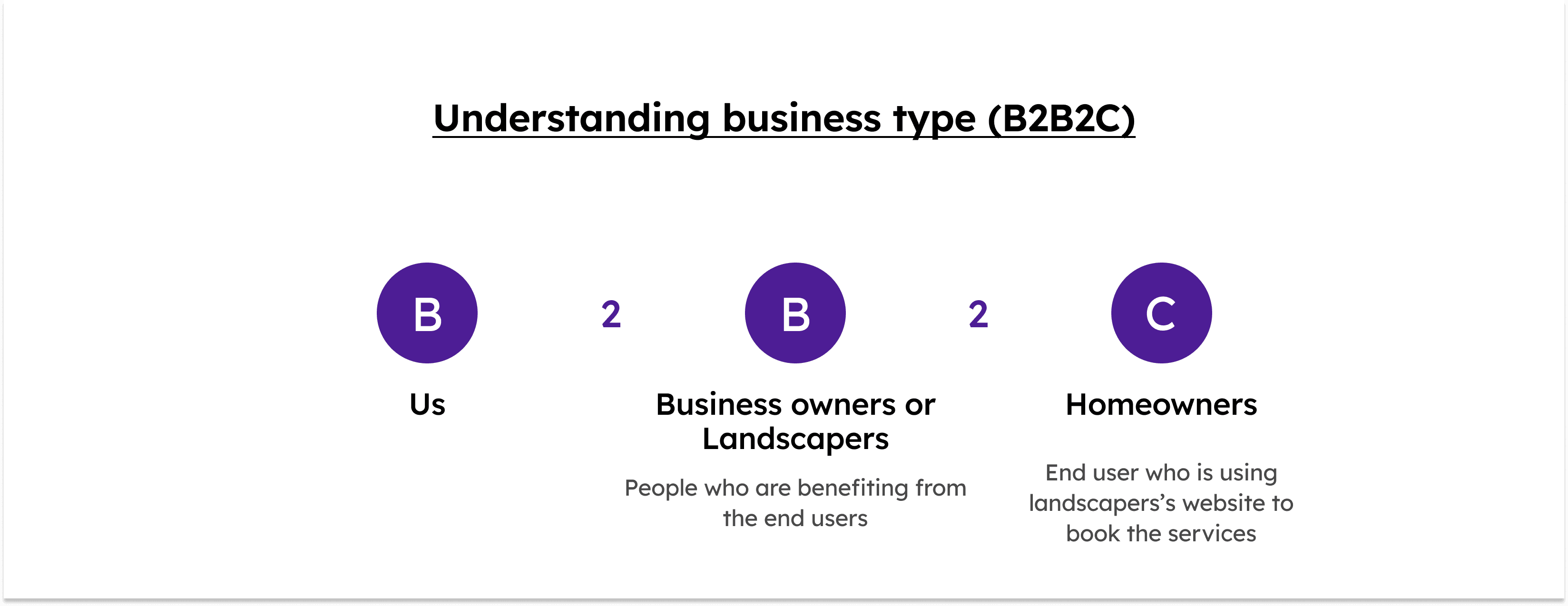
HOW IT WORKS
The current residential landscaping involves activities that change/enhance visible features of an area of land. Landscaping includes installing/maintaining/designing gardens, trees, plants, shrubs, and lawns, as well as landscape care and maintenance services which are performed on a certain features (Lawn, Beds, Edges, Trees, etc.) of the landscape. To get accurate quote value of the amount that the customer has to bear they need instant measurements of these features. Refer below diagram to understand how it works.
Feature name
(Measured by ML)
Measurments
Landscaping company
service rates
Quote value
Lawn
100 sqft
$40/sqft
$4000
Beds
200 sqft
$80/sqft
$16,000
I researched more about how the current process of service booking works for a homeowners and what are the Pros and cons of each method. Click "Know more" to dive right in.
Know more
OUR DIFFERENTIATOR
At this point we figured our differentiator was the measurements that happens to be our secret sauce which differentiates us from our direct competitors.
USER INTERVIEWS
After learning and researching on the industry level information we conducted user interviews to understand the problem more deeply. We created a set of questions for the interview. Click below to know more.
User interview
Key takeaways from user interviews:
a. Business Owner problems:
Dealing with flight by night competition
Customers are also lost due to services not getting booked instantly.
Customers retention is another concern that sometimes get lost and the landscaper is not able to track or pursue them in future.
Not having measurements at the time of booking services restricts landscapers to provide opportunities for upselling services.
Inaccurate underquoting/over-quoting. Underquoting ruins profit margins and over quoting results in lost lead.
b. Homeowner problems:
Hard to trust the landscaping services without having to have quote value.
Not able to see the measurements of property and get assurance of every clear.
Customers want to book services and forget. Rather currently they have to trace the landscaper for the service related updates and the pricing breakdown in particular.
Pricing is hidden and hence just booking services without having to know the cost that customer have to bear it leave them no where.
No option to schedule the services as per their own availability.
Redefining problem statement
A homeowner (the user), who lands on a landscaper’s website, should be able to generate an
(i) instant, (ii) accurate, and (iii) fully automated
quote based on the service he requires, and book the job by making payment to the landscaper then and there. He should also have a clarification around the cost briefing and how the quote is calculated.
Ideate
When we started to ideate we defined a goal for achieving the solution by laying down the common points between both the personas as the end users are homeowners but the business owner is indirectly a user as well. So scoping out at a broader level.
Assumptions:
1. Lawn care companies have a defined service area
2. Lawn-care companies may want a minimum revenue/visit
3. Lawn-care companies may want a minimum/maximum property size based on their operational capabilities.
4. Lawn-care companies would not want to serve customers beyond their service area
5. Running a referral program might be difficult without a proper management tool
6. Referrals would have the highest conversion rate. Online channels would have the lowest conversion rate.
Brainstorming:
1. Reduce physical site visits for the landscaper and show his customers the measurements upfront.
2. How might we show the cost breakdown: For this we had to understand the cost dependencies so we asked the product managers for eg. Quote depends on measurement's, some other service related questions which are service dependant, and the discounts and payment methods available for the customer.
Measurements > Service selection > Service dependent questions > Payment offer.
3. For customer retention-we thought of having an efficient sign up/sign in process. So that basic contact details of the homeowner is achievable to the business owner.
Information architecture:
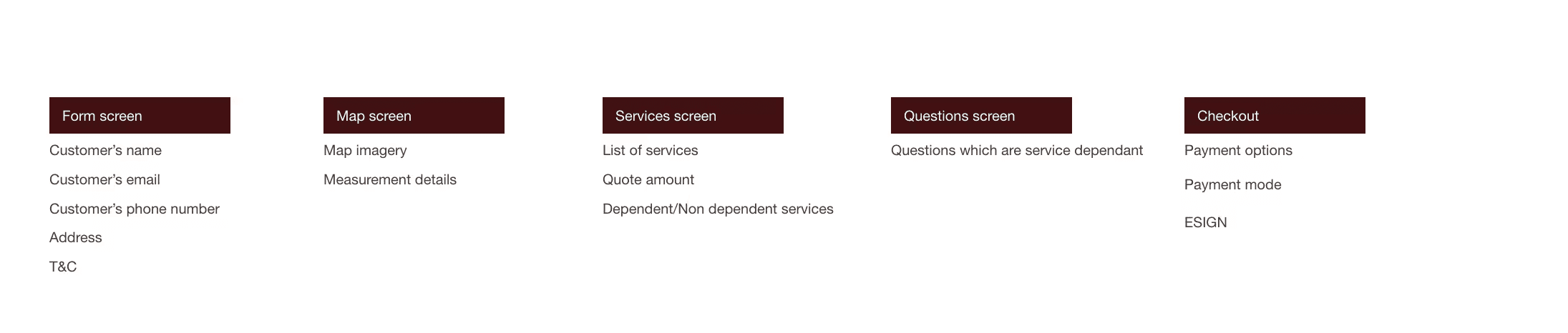
Things we gathered at the end of the ideation phase are:
1. Details screen- Lead capture gets easy.
2. Map screen and choose services- This will solve the concern of homeowners getting to choose the services and see the measurements in real time as well.
3. Service based questions- Some questions related to the chosen services.
4. Checkout & Payment- Giving option to homeowners to view all discounts in front of them and book.
Discovering edge case scenarios:
Design critique
At this point, I figured out cases that might obstruct user flow. This was Map Screen where measurements get populated. So I reached out to the development team around how the data is fetched and how ML works. Next, I made a user flow diagram to handle these edge cases. These edge cases were:
1. Property fetched is correct
2. Business owner denies to serve a particular address
3. Property boundary outside BO's area of operations
4. Property boundary incorrect- Not homeowners property

Design
NOTE:
To keep the case study concise, I will discuss the design process of one of the problem statements. However, if you wish to see the entire design process click below. This link might take time in loading.
View full design process
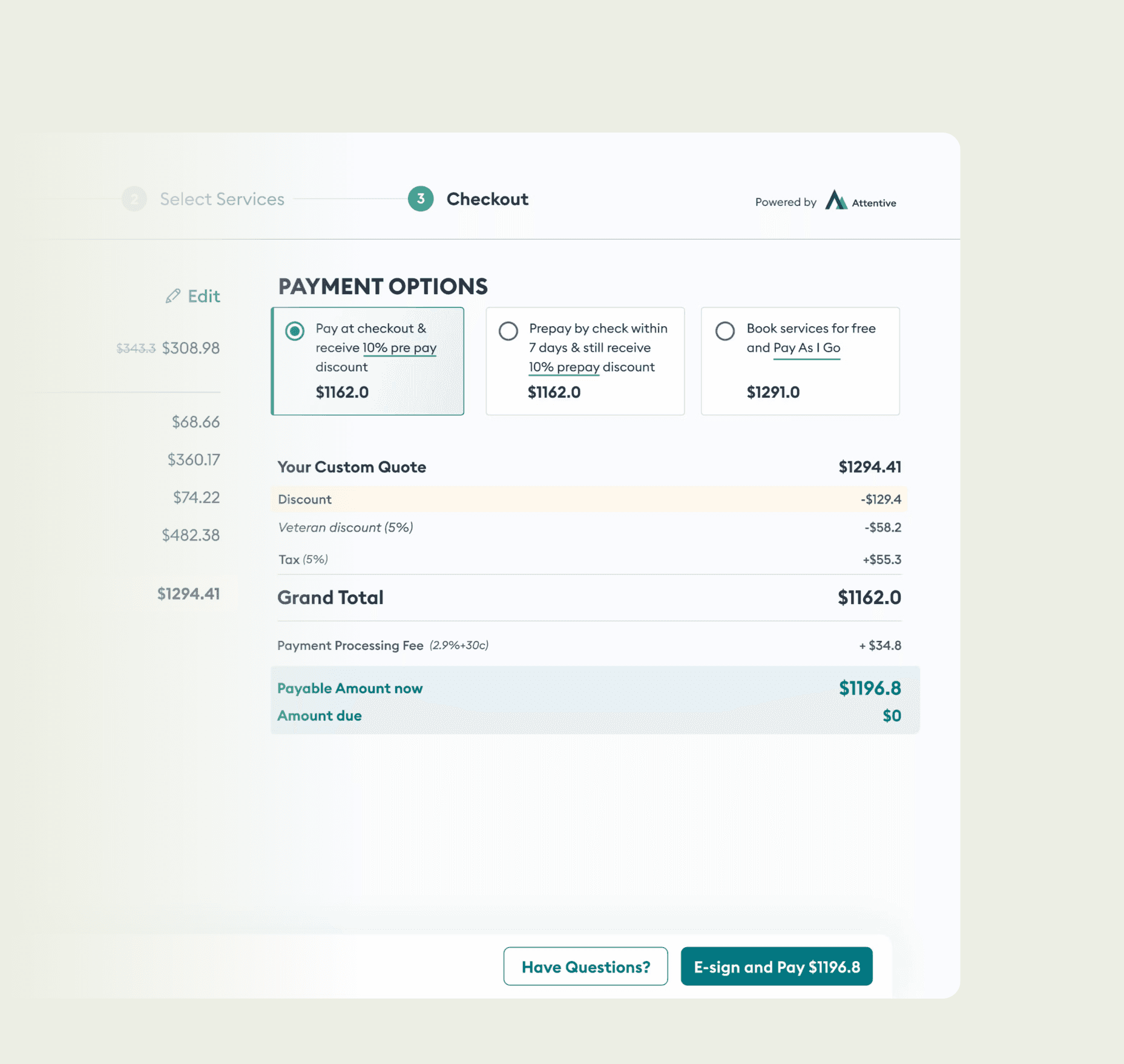
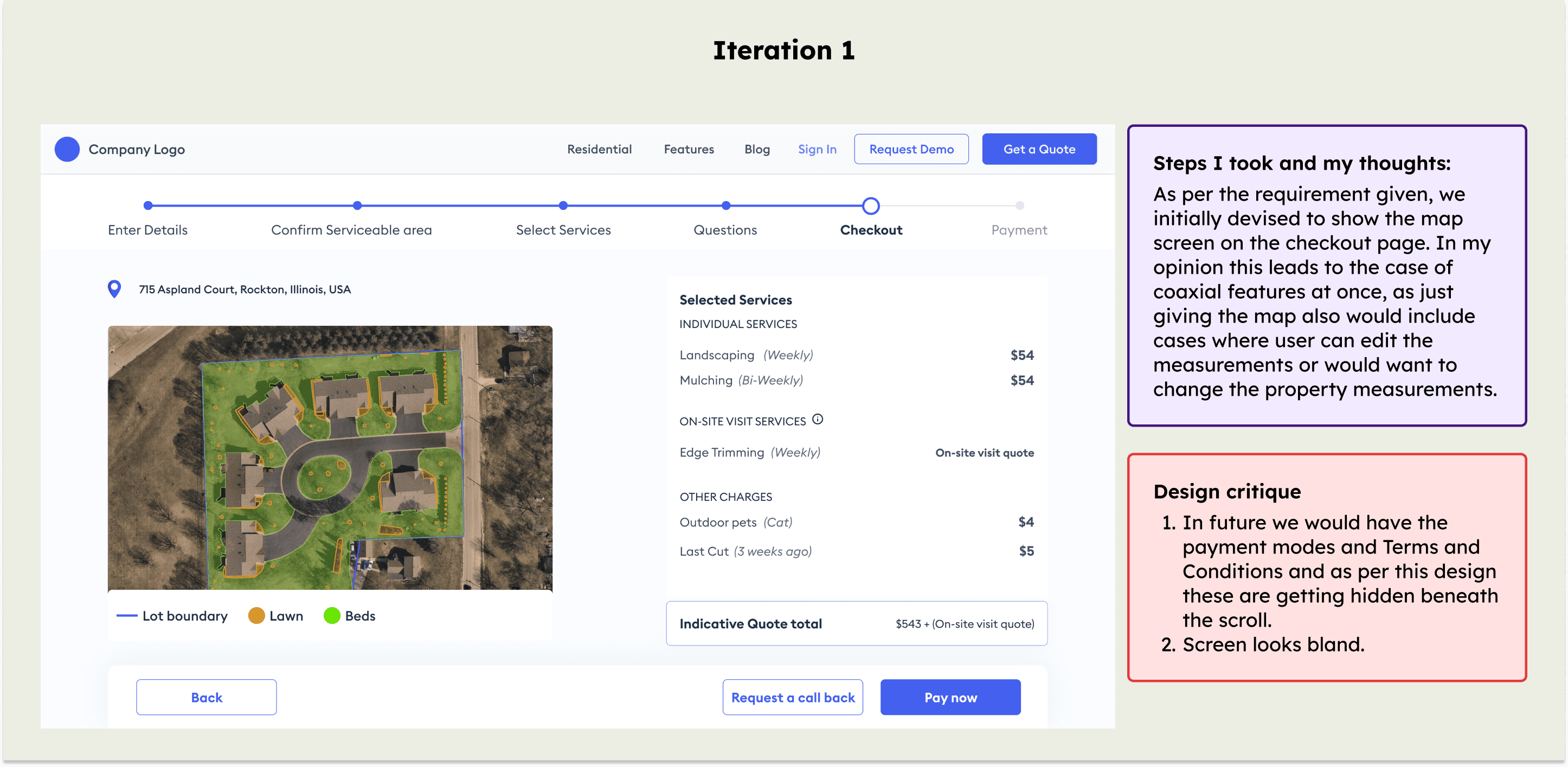
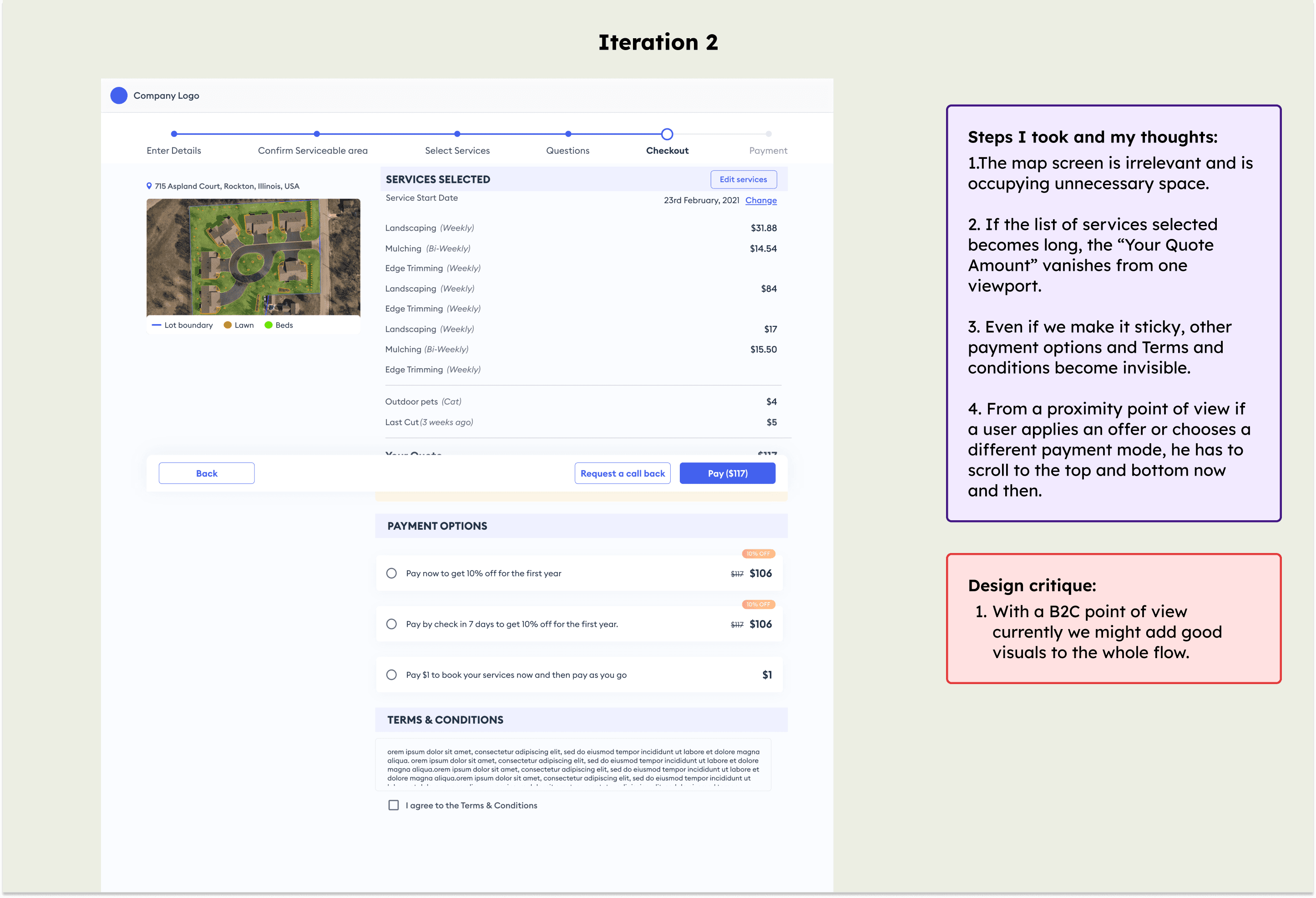
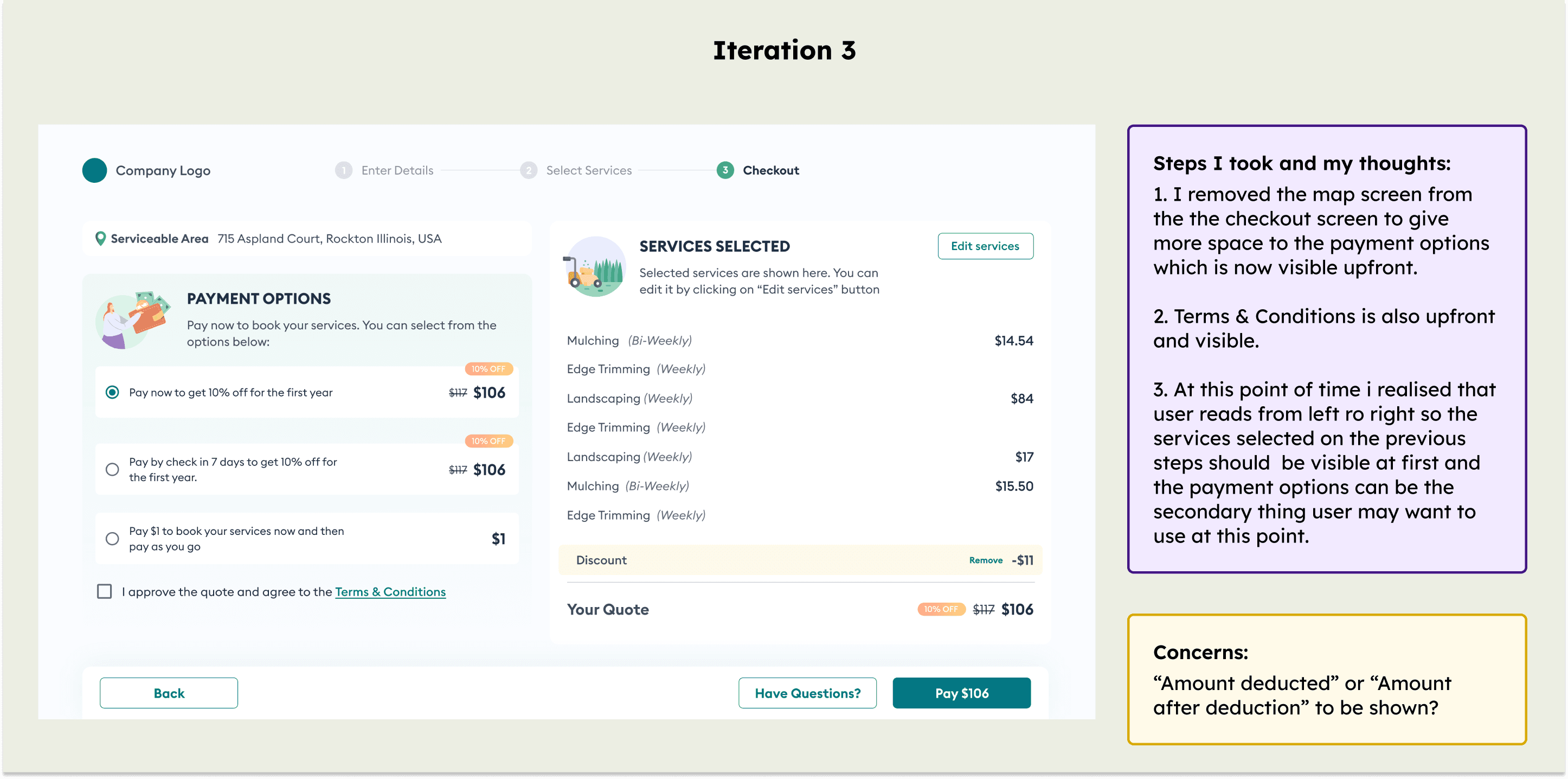
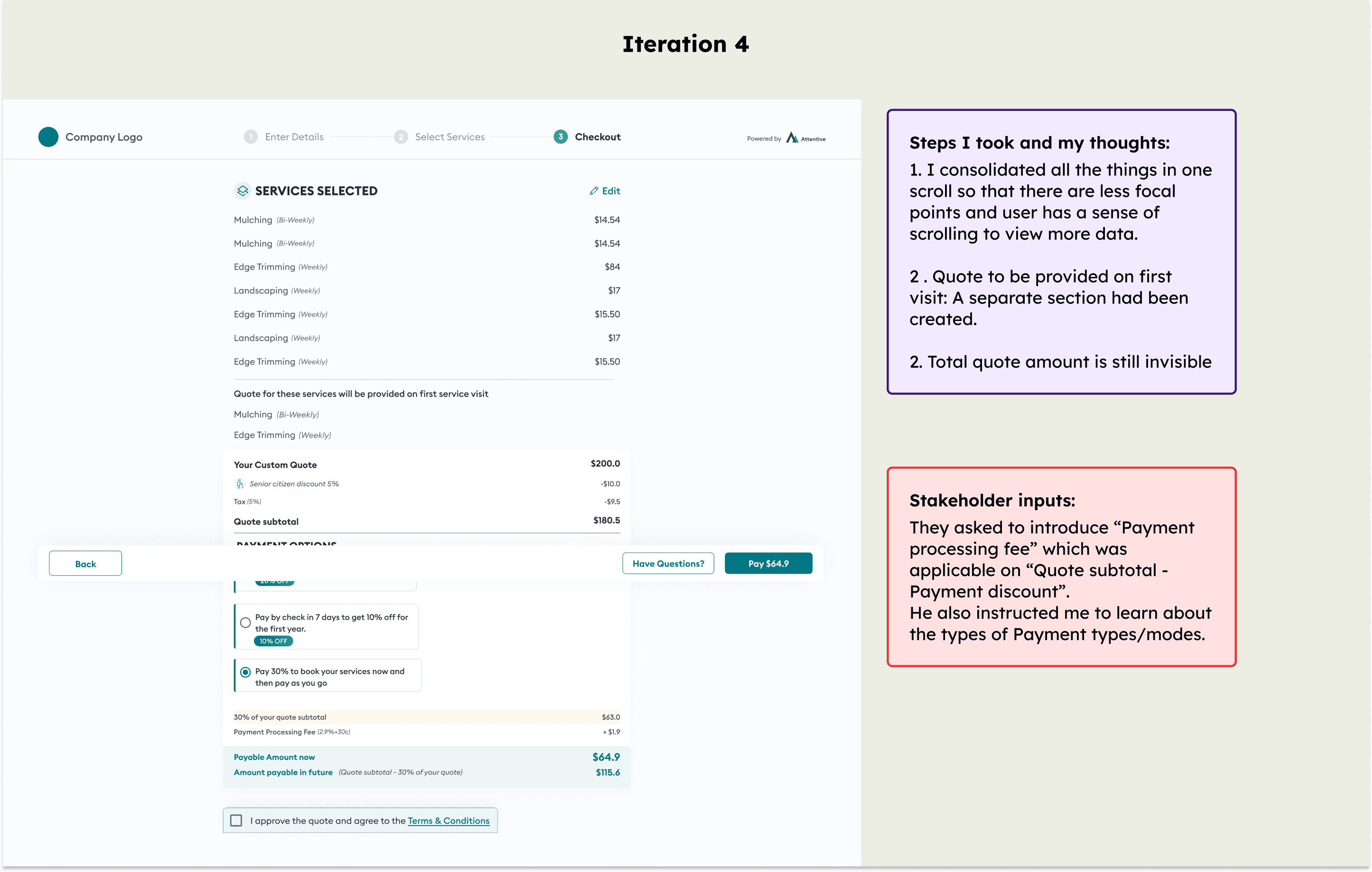
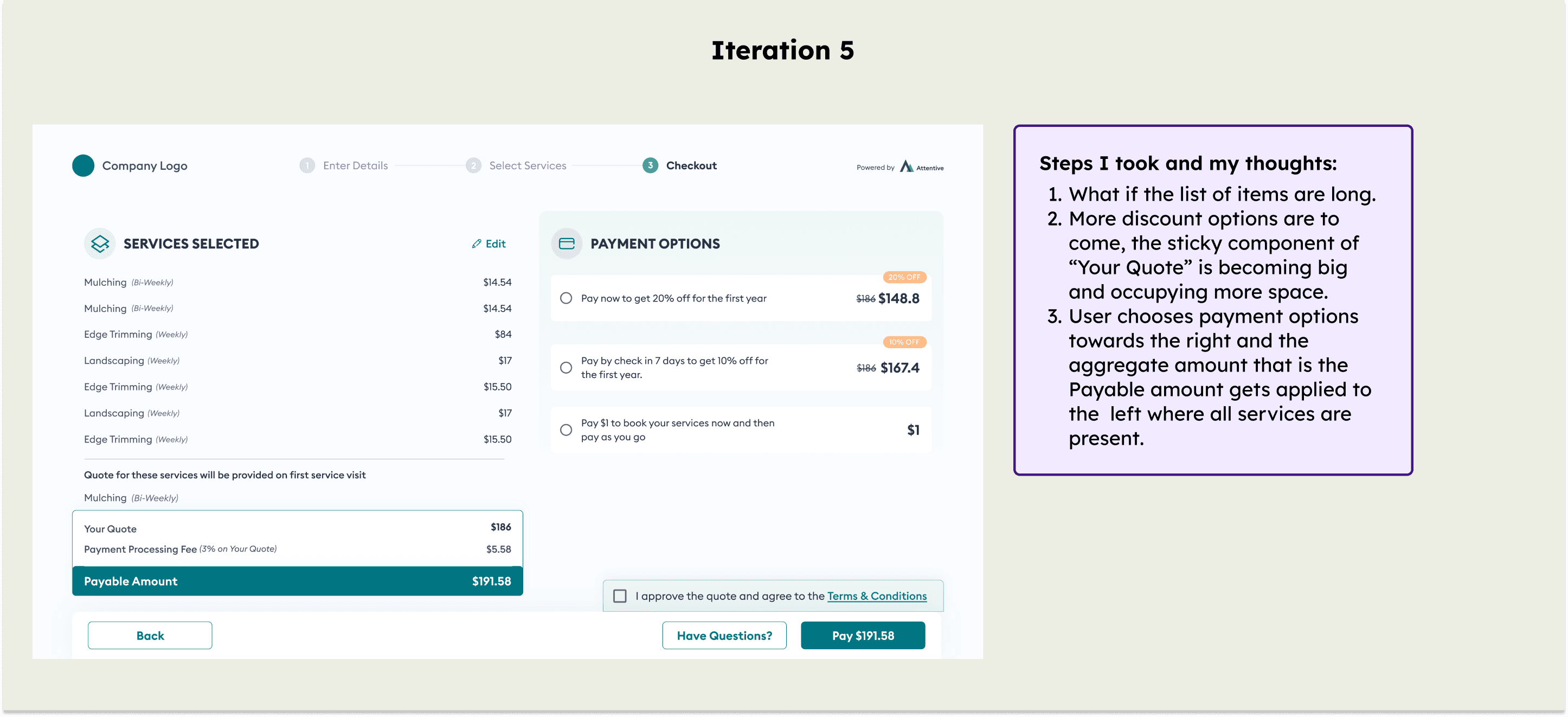
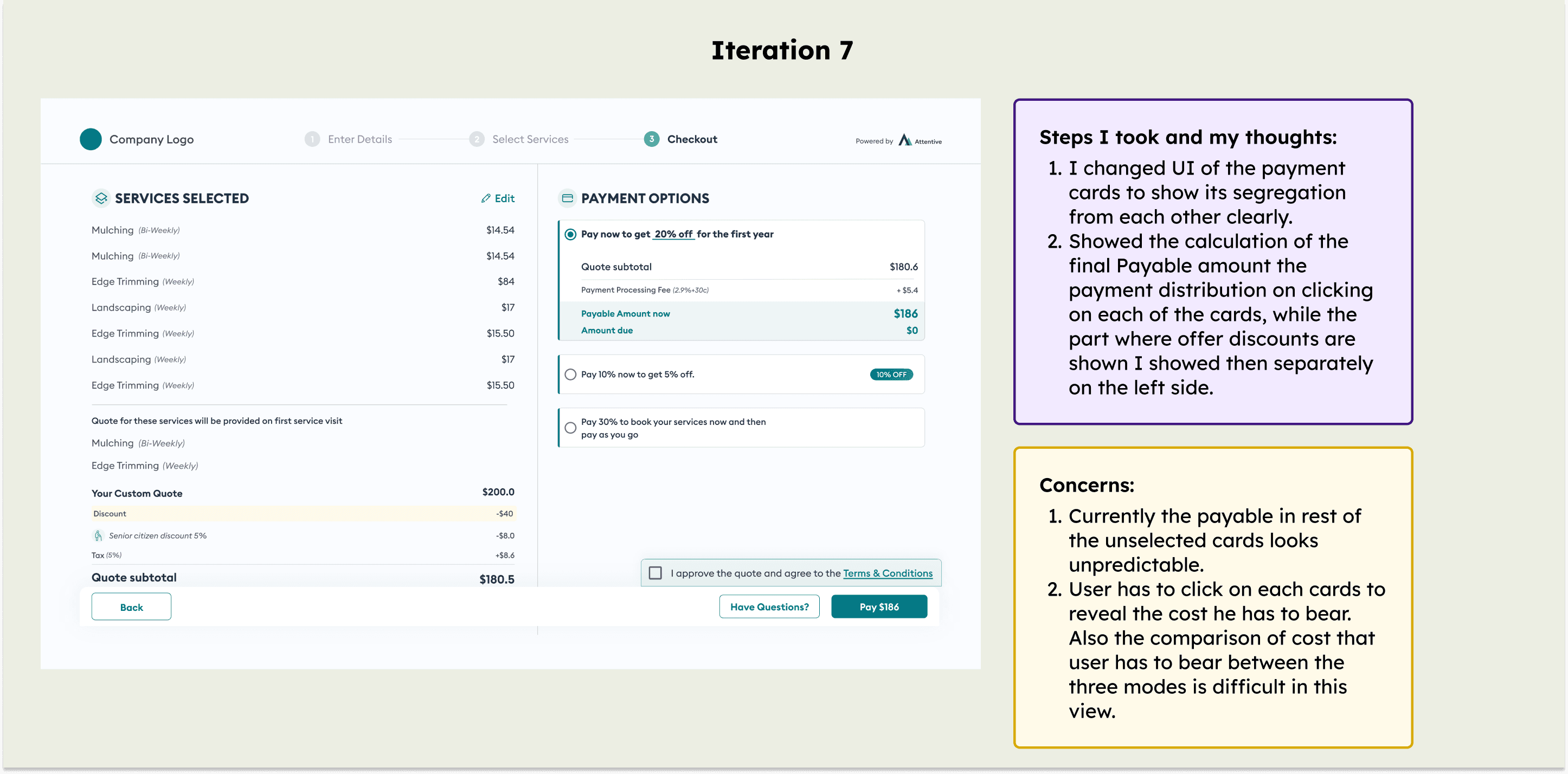
Checkout experience
Problem: Homeowners have less transparency of the cost they have to bear by the end of the service booking tenure.
Goals
To solve these two cases:
1. Layout: On a checkout screen what shall go on the checkout experience as per the problem statement.
2. Designing the cost distribution structure, including an understanding of pricing and tax considerations.

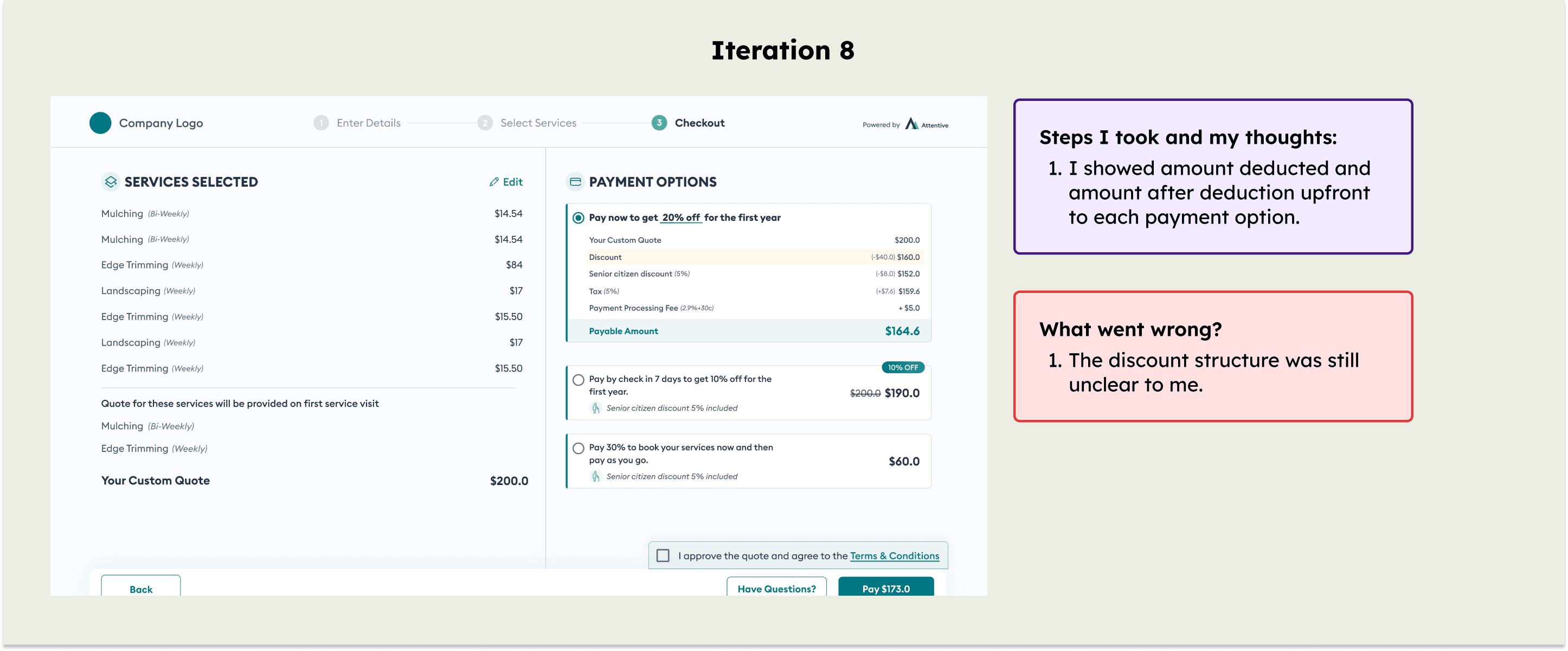
A major setback:
Once I devised that the payment mode is what was tricky, I gave some bandwidth to understand "how it works". I discovered all the types of cases probable for offering discounts. Listing some of them below:
1. Pay 'x%' now to get additional 'y%' discount.
2. Pay now and get 'x%' discount
3. Pay by check in 7 days to get 'x%' discount
4. Pay 'x%' to book your services and then pay as you go.
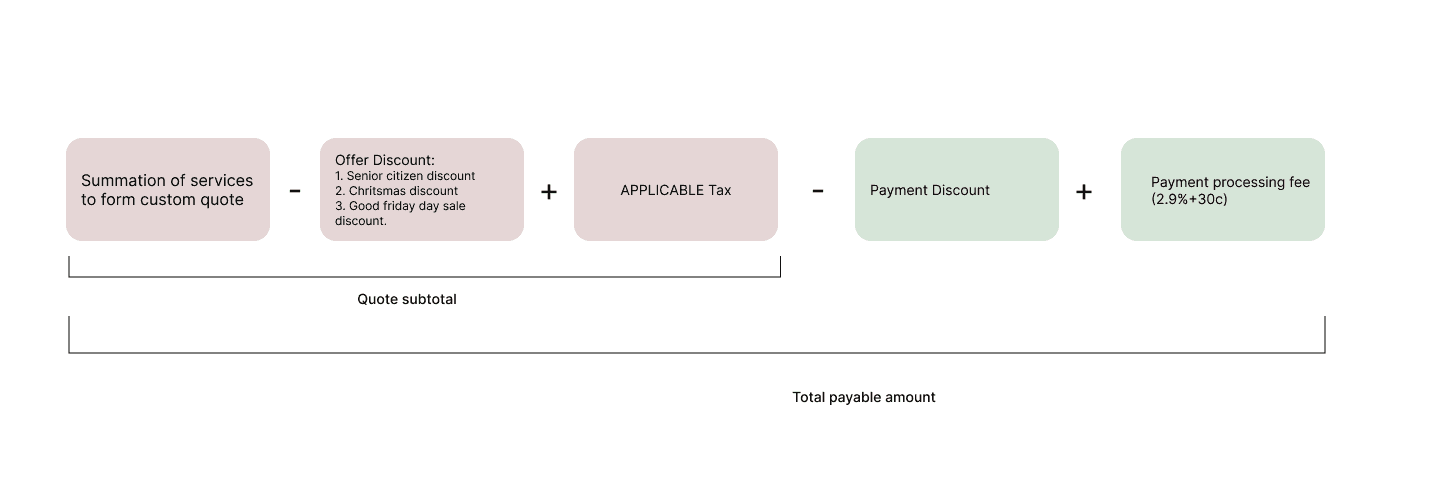
The residential landscaping industry have special discounts or seasonal discounts and then they have payment discounts. To enhance my understanding further, I constructed the following diagram elucidating the process of generating the final quote.

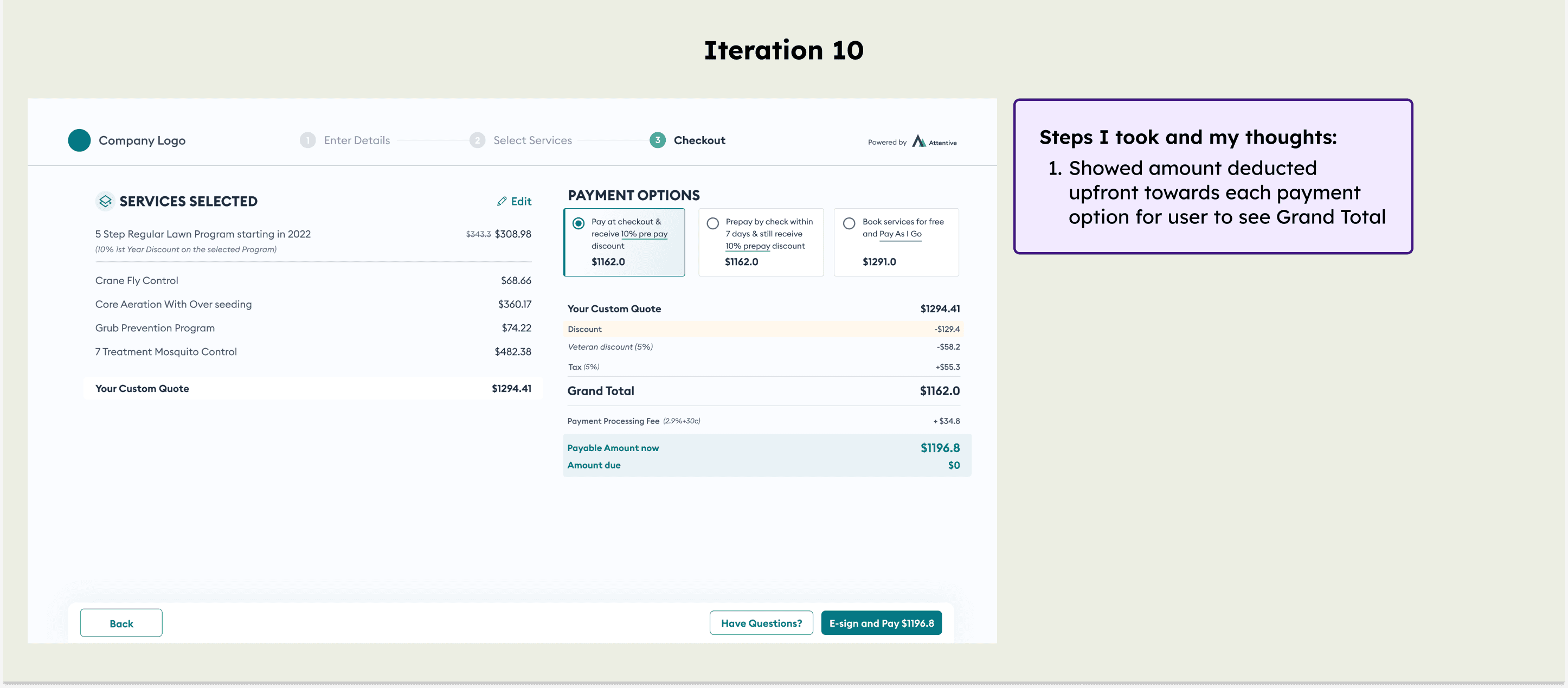
Outcome
After the project went live, we witnessed a substantial increase in revenue. Additionally, we implemented an NPS rating tool to gauge the customers' perception of the booking journey's ease. Over the course of six months, we achieved an impressive average NPS score of 87.9%.
Learnings
Stay in close communication with product managers for continuous feedback.
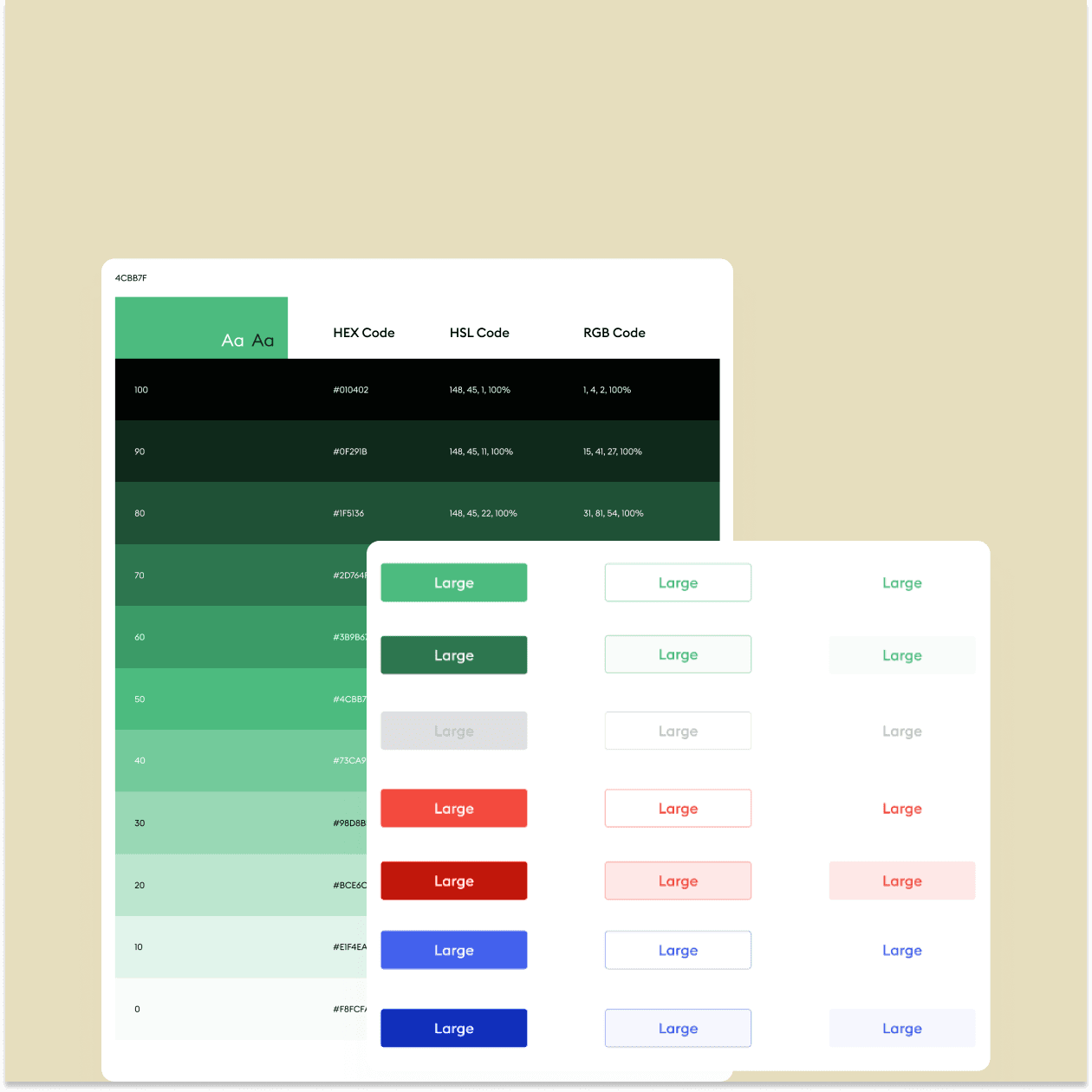
When designing for B2B2C, consider the design system's style guide and each business's brand guidelines to reflect their software for their customers. Look into the business's repository for primary and secondary color palettes to make informed decisions.
Simplify the cognitive load for users; for example, streamline the steps in the booking process.
Understand backend intricacies like API calling and AI limitations to handle edge cases carefully.
Learn from new experiences, such as improving the checkout process for complex discount calculations.